The Russo-Ukranian
War

Vicinity makes people care

A war in 2025 and in Europe seemed something out of a dystopic novel, but here we are.
The minds of humanity are still corrupted and we don't seem to be learning from the past.
The Russo-Ukranian War is the perfect example of how progress is still in the hands of the powerful.

Invasion progression

With the Crimean occupation in 2014, the tension between Russia and Ukraine started to concretize: in 2022 this cold-shoulder became a war, that has been progressing since.
Everyday, the Russians are trying to push the boundaries and conquer more and more areas of Ukraine.
We observe how their advance is progressing.

The plot represents the possession of all Ukraine territories between 2022 and 2024.
Before the 2022 Russian invasion, Moscow controlled less than 10% of the Ukrainian land, as expected after the Crimean dispute.
After the occupation of February, Russia assumed control of more than one fifth of Ukraine, reaching a peak of 22%.
The data shows that, in almost three years, Russia maintained the possession of around 20% of Ukrainian territory.
It's scary to think that in normal conditions the plot should present only the green color, as the totality of Ukraine should be under Ukrainians' possession.

Kremlin

Economy

This conflict is near us, both from a geographical and economic point of view, and we know very well how everything revolves around interests.
One of the main topics of discussion was not centered around the health and welfare of the populations directly involved, but around the possibility of a Russian block to our natural gas supply.
As war progressed, the EU had to reinvent its strategy in terms of importing the supplies, and it had to readjust to new partners.

We take a look at how EU's dependency on Russian resources changed in the years immediately before and after the start of the war.
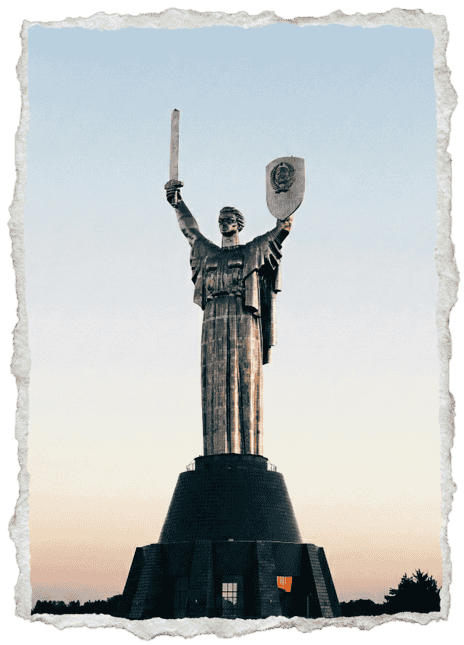
Monument in Kyiv

Even if the start of the tensions was back in 2014, before the actual start of the war we relied very much on Russia's export.
As the war progressed, we tried to become more and more independent from it.
The EU decided to cut completely the dependency from Russia by 2026.

At the end, there's always money on the table.
The EU knew that Russia wasn't a trustable partner, but it still kept the agreements because it was convenient.
Now, fate made us choose between helping Ukraine and saving the economy or continuing depending on Russia and agree with the wrong side of the history.
Thankfully, this time, being the good guy and choosing what's best for us seems to align.

Industry
arrow_warm_up arrow_warm_up